
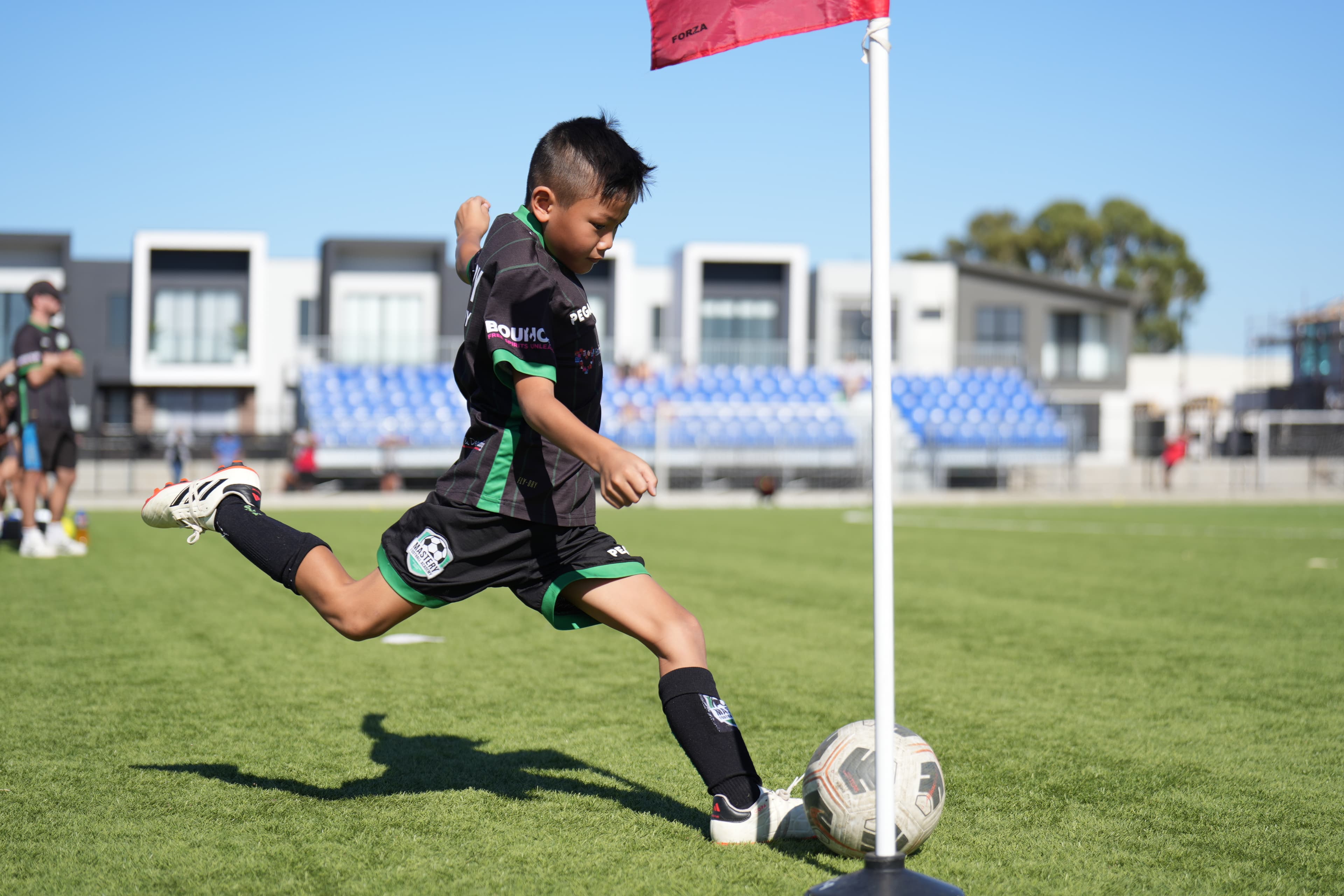
More Than Just Running Around
Parents usually enrol their child in soccer for fitness and fun. Both are good enough reasons. But after coaching hundreds of Adelaide kids, we've seen how much more it does. Here are ten benefits that go well beyond the obvious.
1. Full-Body Cardiovascular Fitness
Soccer involves continuous movement — sprinting, jogging, walking, changing direction — which makes it one of the most complete cardiovascular workouts available for young bodies. Children who play regularly develop strong hearts and lungs, healthy body composition, and the habit of active movement that they're more likely to carry into adulthood.
2. Coordination and Motor Skills
Controlling a ball with your feet while moving, monitoring teammates and opponents, and making split-second decisions is extraordinarily complex for the brain and body. Regular soccer training builds neural pathways for coordination, spatial awareness, and fine motor control that benefit children in sport, school, and daily life.
3. Confidence and Self-Belief
There's something uniquely powerful about mastering a skill. The first time a child successfully beats a defender, scores a goal, or executes a technique they've been practising — the look on their face says everything. That feeling of competence, earned through effort, is one of the most powerful builders of genuine, lasting confidence.
This is why quality coaching matters: a child who progresses with expert guidance experiences regular moments of "I can do this" rather than repeated frustration.
4. Resilience and Coping with Failure
Sport teaches children that failure is normal, temporary, and instructive — lessons that take many adults decades to learn. A missed penalty, a lost game, a skill that takes weeks to master: these experiences, in a supportive environment, build the psychological resilience that helps children navigate challenges in school and life.
5. Teamwork and Social Skills
Soccer is inherently collaborative. Even the most talented individual player cannot succeed without teammates. Children learn to communicate, trust others, support without the spotlight, and subordinate their individual desire to a shared goal. These are skills that employers, schools, and families value more than almost any technical ability.
6. Focus and Concentration
Modern children face unprecedented competition for their attention — screens, notifications, constant stimulation. Soccer requires them to focus: to read the game, anticipate movements, follow instructions, and make decisions in real time. Regular training is genuinely good for a child's ability to concentrate in environments that require it — including school.
7. Emotional Regulation
Soccer provokes emotion: the elation of scoring, the frustration of conceding, the anxiety before a big game. In a well-run program, coaches help children navigate these emotions productively — celebrating without arrogance, losing without meltdown, feeling nervous and performing anyway. This emotional education is invaluable.
8. Respect for Authority and Peers
Following a coach's instruction, accepting a referee's decision, respecting an opponent: soccer builds a framework of appropriate deference and respect that genuinely transfers. Parents often tell us their child's behaviour at home improved after joining the program — because they're learning that rules exist, adults deserve respect, and fairness matters.
9. Problem-Solving and Decision-Making
Every moment in soccer is a decision: pass or shoot? Go forward or hold? Press or drop back? Children who play regularly develop rapid, intuitive decision-making abilities and learn to read complex, dynamic situations quickly. This kind of practical intelligence is one of the most transferable cognitive skills in existence.
10. A Lifelong Relationship with Physical Activity
Children who love sport in childhood are far more likely to be active adults. Given what we know about the health benefits of lifelong physical activity, giving your child a sport they love — and the skills to keep playing it — may be one of the most valuable gifts you can offer them.
How to Make the Most of These Benefits
Every child who plays soccer gets some version of these benefits. But a program with real coaching — individual attention, honest feedback, the right group — delivers them much more reliably than one that just parks kids on a pitch and lets them run around.
If you're looking for that kind of program in Adelaide, find your nearest Mastery session and try it free for two weeks.